Guide to Choosing the Best Speakers For Restaurant Sound Systems

The best sound system for a restaurant or café in Dubai is not the loudest one — it is the one that sounds the same at every table. That means ceiling speakers spaced 3–4 metres apart, split into zones for the dining room, bar and terrace, each with its own volume control. Equipment for a 50-cover café starts from around AED 1,200; a 100-cover restaurant with a terrace is around AED 3,500, before installation.
Why Sound Matters More Than Ever for Restaurants and Cafés
Picture a Friday evening in a busy Dubai restaurant. The bar is full and someone turns the music up so the bar crowd can feel it. Twenty metres away, a family in the corner can no longer hear each other across the table — they skip dessert and ask for the bill. Nobody complains. They just don’t come back. That is the problem most venues have: not bad speakers, but one volume for the whole room. In 2026, sound has become part of a venue’s identity, just like lighting and interior design. Guests don’t only taste your food and coffee; they hear your atmosphere. When it is too loud, uneven or tinny, it shows up in your reviews. This guide shows restaurant and café owners in Dubai how to choose the right speakers, lay out zones, set the right volume, and budget for a 50, 100 or 200-cover venue.
What You’ll Learn
- How to match a sound system to a café or restaurant’s size and layout
- Ceiling, pendant, wall, outdoor and subwoofer speakers — when to use each
- Zone plans and real AED budgets for 50, 100 and 200-cover venues
- How to set volume with a free SPL meter app
- How to keep the system working in UAE heat, dust and humidity
Understanding Your Venue’s Sound Needs
Every venue has a different sound profile, and cafés and restaurants need different things.
- Cafés need quiet, even background music. Guests are working on laptops, meeting or talking — the music should fill silence, not compete. Coffee grinders and milk steamers add noise near the counter, so the counter usually needs its own zone.
- Restaurants need a balance: enough energy to feel lively, never so loud that people raise their voices. Most have at least three areas — dining room, bar and terrace — that need different levels at the same time.
- Size: a small café may need six to eight ceiling speakers; a 200-cover restaurant may need nearly forty across five zones.
- Layout: the bar wants more punch, private dining wants less, and terraces need weather-resistant speakers.
- Audience: families and business lunches want calm music around 60 dB; a younger late-evening crowd may be comfortable at 70–75 dB in the bar.
| Venue | Target level | Why |
|---|---|---|
| Specialty café / laptop crowd | 55–62 dB | Background only — people are working and talking |
| Family restaurant | 60–65 dB | Conversation across the table must be easy |
| Fine dining | 55–62 dB | Quiet enough to talk at a low voice |
| Casual dining / brunch | 65–70 dB | Energy without shouting |
| Lounge bar, late evening | 70–78 dB | Music is part of the product |
Pro tip: download a free SPL meter app, sit at three different tables during a busy service, and note the readings. If they differ by more than 5–6 dB, the problem is speaker placement, not volume.
How to Pick the Right Speakers
For most restaurants and cafés, ceiling speakers are the right starting point, with pendant, wall or outdoor speakers only where the ceiling or space demands it. Choosing the wrong type is like pairing the wrong wine with a dish — everything else can be right and it still won’t work. 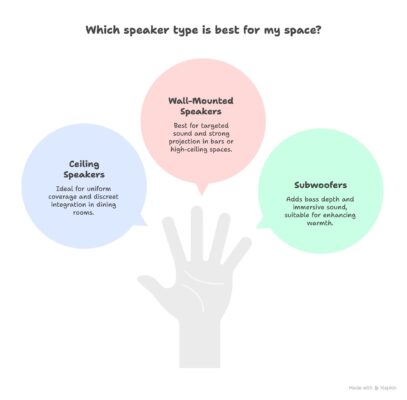
| Speaker Type | Best For | Pros | Cons | Verdict |
|---|---|---|---|---|
| Ceiling speakers | Dining rooms, cafés | Even coverage, invisible | Need a false ceiling | Default choice for most venues |
| Pendant speakers | Exposed or high ceilings | Hang at the right height, design feature | Visible | Lounge bars, industrial interiors |
| Wall-mounted | Bars, high ceilings, retrofits | Aimable, strong projection | Visible hardware | Where ceilings can’t be used |
| Outdoor speakers | Terraces, shisha areas | Weather- and dust-resistant | Need careful aiming | Essential for UAE terraces |
| Subwoofers | Lounges, late-night bars | Warmth and depth | Overpower dining if misused | Add only where music matters |
Ceiling and pendant speakers give the most even sound and disappear into the décor. For venues with exposed ceilings or where the ceiling can’t be opened, wall-mounted speakers are the practical alternative. For terraces, use proper outdoor speakers — standard indoor speakers fail quickly in UAE heat and humidity. Our guide to choosing ceiling speakers in Dubai covers models and placement in more detail. Case example: a Dubai café reduced customer complaints by repositioning two ceiling speakers 3 metres apart instead of 5. After the change, the SPL meter showed balanced coverage, with no loud spots near the tables under the speakers.
Zone Plans and AED Budgets: 50, 100 and 200-Cover Venues
Plan roughly one ceiling speaker for every 12–15 m² of seating, spaced 3–4 metres apart, and give every area that needs a different volume its own zone. The plans below show how that works in practice. They are typical layouts, not specific clients — every venue is surveyed before we quote. Prices are equipment only, from our current range.
| Venue | Floor area | Zones | Speakers | Equipment budget |
|---|---|---|---|---|
| 50-cover café | ~80 m² | 3–4 | 9–11 | 1,233 – 1,813 |
| 100-cover restaurant | ~160 m² + terrace | 4 | 21 | 3,453 |
| 200-cover restaurant | ~320 m² + lounge + terrace | 5 | 38 | 7,638 – 9,999 |
50-Cover Café
A typical neighbourhood café: a seating area, a coffee bar with a noisy grinder and steamer, one washroom, and perhaps a small terrace. The counter gets its own zone so staff can hear orders without the whole room going quiet.
| Zone | Equipment | AED |
|---|---|---|
| Seating | 6 × TADS DS-116 frameless ceiling speaker | 480 |
| Coffee bar | 2 × ALIHA CS-20-S5T ceiling speaker | 110 |
| Washroom | 1 × ALIHA CS-6-5 moisture-resistant | 55 |
| Amplifier | 1 × TOP PRO MP-350 5-zone amplifier | 588 |
| Terrace (optional) | 2 × ALIHA 50W outdoor speaker | 580 |
| Total equipment | Excluding optional items, cabling, volume controls and installation | 1,233 |
| With optional items | 1,813 |
100-Cover Restaurant
A full-service restaurant with a separate bar and a terrace. The bar can run louder in the evening while the dining room stays conversational, and the terrace can be switched off in the afternoon heat. The fifth zone on the amplifier is spare for future use.
| Zone | Equipment | AED |
|---|---|---|
| Dining room | 10 × ALIHA MC-08N frameless ceiling speaker | 1,100 |
| Bar | 4 × ALIHA MC-08N frameless ceiling speaker | 440 |
| Washrooms & BOH | 3 × ALIHA CS-6-5 moisture-resistant | 165 |
| Terrace | 4 × ALIHA 50W outdoor speaker | 1,160 |
| Amplifier | 1 × TOP PRO MP-350 5-zone amplifier | 588 |
| Total equipment | Excluding optional items, cabling, volume controls and installation | 3,453 |
200-Cover Restaurant
A large venue with a main dining room, private dining room, lounge bar and terrace. Pendant speakers suit the lounge’s open ceiling, a second amplifier powers the terrace, and an optional subwoofer adds warmth to the lounge without affecting the dining room.
| Zone | Equipment | AED |
|---|---|---|
| Main dining | 18 × ALIHA MC-08N frameless ceiling speaker | 1,980 |
| Private dining | 4 × TADS DS-116 frameless ceiling speaker | 320 |
| Lounge bar | 6 × TADS DS-645 pendant speaker | 1,680 |
| Terrace | 6 × ALIHA 50W outdoor speaker | 1,740 |
| Washrooms & BOH | 4 × ALIHA CS-6-5 moisture-resistant | 220 |
| Amplifiers | TOP PRO MP-350 5-zone + AHUJA TZA-1500DP 2-zone | 1,698 |
| Lounge bass (optional) | 1 × TOP PRO WHN15APS1 15″ powered subwoofer | 2,361 |
| Total equipment | Excluding optional items, cabling, volume controls and installation | 7,638 |
| With optional items | 9,999 |
Budgets exclude cabling, wall volume controls, a paging microphone and installation, which depend on the building. We check that every speaker and amplifier are the same type — 100V or low-impedance — before quoting; our guide on how many speakers you can connect to an amplifier explains why that matters.
Zones and Control
Zoning is the single biggest upgrade for most restaurants. Treat the venue as separate areas — dining room, bar, terrace, washrooms — each with its own volume. A multi-zone amplifier or a smart streaming amplifier lets you:
- Adjust volume by zone from a wall control or a phone app
- Make announcements in one zone without stopping the music elsewhere
- Run different playlists — calm in the dining room, livelier at the bar
- Turn the terrace off in summer afternoons without touching indoors
Why it matters: without zones, the bar shouts over the music while diners at the back barely hear it — the Friday-night problem at the top of this guide.
Installation and Maintenance in the UAE
A great system badly installed sounds worse than a basic one installed well. A few things matter more in the UAE:
- Get a site survey first. The ceiling type, AC ducts and sprinklers decide where speakers can go. We survey before quoting.
- Clean speaker grilles every few months. Grilles near AC returns collect fine dust quickly and muffle the sound.
- Check terrace speakers before summer. Heat, sand and humidity are hardest on outdoor units and cables.
- Update streaming amplifiers and apps. Passive speakers don’t need updates, but smart amplifiers and music apps do.
- Re-check levels every quarter. Busy seasons, new furniture and layout changes all affect how the room sounds.
Pitfall: skipping cable checks. Loose or damaged connections cause “mystery” dropouts. Fix: inspect connections every six months and replace damaged cables straight away. See our guide to audio cables in Dubai.
Troubleshooting and Quick Fixes
- Uneven sound between tables? Check spacing — speakers more than 4–5 metres apart leave quiet gaps. Add a speaker rather than turning up the volume.
- Loud directly under a speaker? Too few speakers running too loud. More speakers at lower volume fixes it.
- Distorted or boomy bass? Lower the subwoofer level, or limit it to the bar zone.
- One speaker dead? Check the cable and its connection first before replacing the speaker.
- Echo? Hard surfaces reflect sound. Add soft furnishings, or use more speakers at a lower level.
- Staff can’t hear orders at the counter? Put the counter on its own zone and keep it lower.
FAQs: Restaurant and Café Sound Systems
How loud should a restaurant or café be? Most restaurants aim for 60–70 dB — loud enough for atmosphere but quiet enough for conversation. Cafés and fine dining sit lower, around 55–62 dB, while lounge bars may go to 70–78 dB late in the evening. Measure at several tables with a free SPL meter app. How many speakers does a restaurant need? Allow roughly one ceiling speaker per 12–15 m² of seating, spaced 3–4 metres apart. A 50-cover café typically needs 9–11 speakers, a 100-cover restaurant with a terrace around 20, and a 200-cover venue closer to 40 across five zones. How much does a restaurant sound system cost in Dubai? Equipment typically costs about AED 1,200–1,800 for a 50-cover café, around AED 3,500 for a 100-cover restaurant with a terrace, and AED 7,500–10,000 for a 200-cover venue with a lounge and terrace. Cabling, volume controls and installation are quoted after a site survey. Where should restaurant speakers be placed? Space ceiling speakers evenly, 3–4 metres apart, so each table sits between speakers rather than directly under one. Keep them about a metre from walls. Wall speakers work best angled toward the tables, slightly above head height. Should a restaurant use wired or wireless speakers? Wired speakers are the better choice for permanent installations — they are reliable and consistent every service. Wireless speakers suit temporary or outdoor events but can drop out. Many venues use wired speakers with a wireless streaming amplifier for control. Do cafés need a different system from restaurants? Cafés usually need fewer, smaller speakers at a lower volume, and a separate zone at the counter so staff can hear orders over grinders and steamers. Restaurants need more zones — dining, bar, terrace — because different areas want different levels at the same time.
Plan Your Venue’s Sound
Send us your floor plan and seat count and we’ll suggest a zone plan, speaker count and equipment budget — with supply and installation across the UAE. Speakers and amplifiers are in stock at our Dragon Mart shop (Shop AAG-11/12, near BA Gate parking, open daily 10:30–22:00) to take away the same day. WhatsApp: +971 58 928 1994