Trending Stage Lighting Techniques for Nightclubs

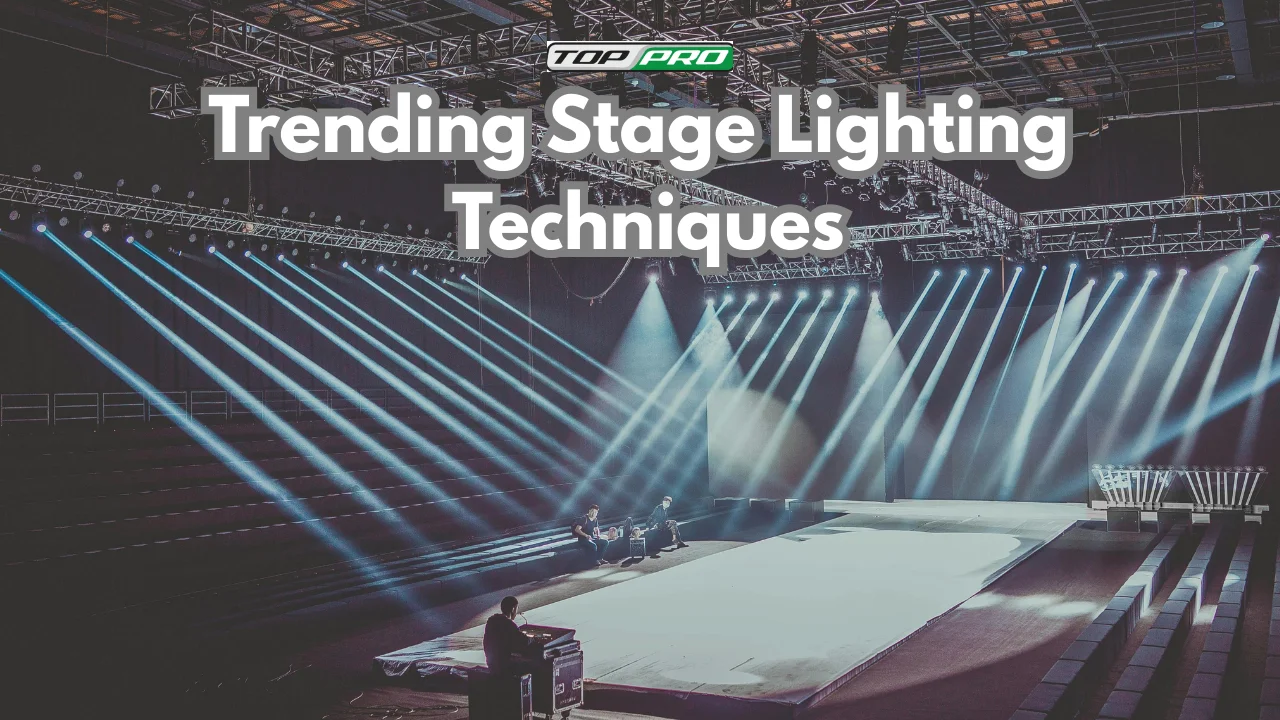
A nightclub lighting rig has one job: move the room. Not to look impressive when the lights are up, but to make a crowd feel the drop before they hear it land.
This guide covers the lighting systems a club actually needs, the techniques that create energy, design ideas by zone, and what a working rig costs in the UAE.
Which Lighting Systems Are Recommended for Nightclub DJs?
A club DJ rig needs five systems working together. Miss one and the room feels flat no matter how much you spent on the others.
| System | What it does | Typical fixtures |
|---|---|---|
| Beam / aerial | Movement and drama in the air above the crowd | 4–8 beam moving heads |
| Wash | Colours the room and the crowd | 4–8 wash moving heads or LED PARs |
| Impact | Hits the crowd on drops | 2–4 strobes or blinders |
| Atmosphere | Makes every beam visible | 1–2 haze machines |
| Control | Ties it to the music | DMX controller or software |
The one that gets skipped is atmosphere — and it is the one that makes the rest work. Beams are invisible in clean air. A club that spends AED 6,000 on beam moving heads and nothing on haze has bought fixtures nobody can see.
Minimum viable DJ club rig: 4 beam moving heads, 4 LED PARs, 2 strobes, 1 haze machine, 1 DMX controller. Everything above that is refinement.
Shop: beam moving heads, moving head wash, strobe & blinder lights, fog machines and stage lighting control.
Nightclub Lighting Techniques That Actually Move a Crowd
Technique matters more than fixture count. Six well-programmed lights beat twenty running random auto-modes.
Build and Release
The core technique in club lighting. Through a build, tighten everything — narrow the beams, raise intensity, speed the movement, drop the colour toward white. On the drop, release: full strobe or blinder, wide beams, hard colour. The contrast is what the crowd feels.
Get this wrong by running everything at maximum all night and the room goes numb inside twenty minutes.
Blackout Before the Drop
Kill every fixture for half a beat before the drop lands. The room holds its breath. Then everything at once. It costs nothing, needs no extra gear, and it is the single most effective move in the toolkit.
Beam Sweeps and Fans
Beam moving heads panning together across the room, or fanning out from a centre point. Reads as motion and scale. Needs haze to exist at all — see the atmosphere section below.
Crowd Blinding
Warm blinders aimed at the dance floor, fired on a chorus or drop. It turns the crowd into part of the show and makes a 200-capacity room feel like a festival. Use it sparingly — twice a set, not twice a track.
Colour Punctuation
Hold one colour through a section, then snap to its opposite on the change. Blue through the build, hard red on the drop. Snap, don’t fade — fades read as smooth, snaps read as impact.
Sound-to-Light — and Its Limit
Sound-active mode makes fixtures respond to audio with no operator. Genuinely useful for early doors, a warm-up set, or a night with no LJ. But it reacts to what already happened, so it can’t anticipate a drop, and against a structured set it reads as random. Programme cues for peak hours; use sound-active for the shoulders of the night.
Pixel Mapping
Controlling individual LED cells to run patterns, text and chases across a bar or wall. High impact for a modern club look, and LED pixel bars are the usual starting point.
Nightclub Lighting Ideas by Zone
A club is not one room. Lighting each zone for its own job is what separates a designed venue from a pile of fixtures.
| Zone | Goal | Fixtures |
|---|---|---|
| Dance floor | Energy and movement | Beam moving heads, strobes, laser, haze |
| DJ booth | Make the DJ the focal point | Backlit booth, LED bars, 2 wash fixtures |
| Bar | Visible, warm, on-brand | Warm wash, LED strip under the counter, bottle lights |
| Seating / VIP | Low, flattering, conversational | Dimmed warm wash, table accents, no beams |
| Walls and architecture | Depth and brand colour | Wall washers, uplighters |
| Entrance | First impression | Gobo logo projection, colour wash |
| Ceiling | Scale | Mirror ball, pixel bars, kinetic fixtures |
Three ideas that consistently pay off:
- Backlight the DJ booth. A silhouetted DJ against colour reads as a headline act. A front-lit DJ reads as staff.
- Light the bar warm, the floor cool. People move toward warm light to drink and cool light to dance. You are steering the room.
- Project your logo on the wall. A gobo in a moving head puts your brand in every phone photo taken that night. Free marketing, one fixture.
Club Lighting Setup by Venue Size
Fixture counts that actually work, rather than a generic list.
| Small bar / lounge (up to 100) | Mid-sized club (100–300) | Large club (300+) | |
|---|---|---|---|
| Beam moving heads | 2 | 4–6 | 8–12 |
| Wash moving heads or PARs | 4 | 6–8 | 12+ |
| Strobe / blinder | 1 | 2 | 4 |
| Laser | Optional | 1 | 2 |
| Wall washers / uplighters | 4 | 8 | 16+ |
| Haze machine | 1 | 1–2 | 2+ |
| LED pixel bars | — | 2–4 | 6+ |
| Control | Basic DMX desk | DMX desk or software | Software or pro console |
| Typical spend | AED 3,000–6,000 | AED 12,000–25,000 | AED 40,000+ |
What Lighting Bundles Create a Dynamic Atmosphere in a Mid-Sized Venue?
For a 100–300 capacity room, the combination that delivers the most visible change per dirham:
- 4 beam moving heads on a truss above the dance floor — aerial movement
- 6 LED PARs as room wash — colour and coverage
- 2 blinders or strobes facing the crowd — drop impact
- 1 haze machine running continuously — makes 1 and 3 visible
- 8 wall washers on the perimeter — depth, and they work even when the floor is empty
- 1 DMX controller — ties it together
That is roughly AED 12,000–18,000 at current pricing and it will out-perform a AED 30,000 rig with no haze and no programming.
Nightclub Lighting Design Principles
Design for the Empty Room Too
A club is empty at 9pm and full at 1am. Wall washers, bar lighting and architectural colour carry the room early. Beams and strobes are for peak. A rig that only looks good at capacity makes the first three hours feel dead.
Contrast Is the Whole Game
Lighting that never changes stops registering within minutes. The crowd feels difference, not brightness. Build quiet sections so the loud ones land.
Don’t Light the Whole Room Evenly
Even light is what offices do. A club wants pools, shadows and depth — bright dance floor, dim seating, glowing bar. Darkness is a design element, not a failure.
Respect the Eyes
Strobes fatigue people fast, and lasers must never hit the crowd at eye level. Keep laser beam paths above head height, and treat strobe as punctuation. A room that hurts to stand in empties early.
Colour Choices and What They Do
| Colour | Feel | Use for |
|---|---|---|
| Red / orange | Heat, urgency, intensity | Peak hour, drops |
| Blue / cyan | Cool, spacious, deep | Builds, breakdowns, house sets |
| Purple / magenta | Luxury, glamour | VIP areas, brand colour, R&B nights |
| Green | Alien, sharp, high contrast | Accents and beam work — harsh as a full wash |
| Warm white | Human, inviting | Bar, seating, closing the night |
| UV / blacklight | Neon glow on white | Themed nights, body paint, foam parties |
Colour temperature for white light: warm (2700–3000 K) for lounge and bar, cool (5000–6500 K) for a crisp modern dance floor. UV PAR fixtures are worth owning for themed nights alone.
Rave, EDM and Disco Variations
Rave and EDM lean hard on beams, strobes, lasers and heavy haze. Fast movement, aggressive colour snaps, blackouts before drops. Fixture priority: beams first, lasers second, wash last.
Disco and retro nights want a mirror ball with a tight pin spot, warm colour, chase patterns and slower movement. The mirror ball only works with a narrow beam hitting it — a wide wash produces nothing.
Hip-hop and R&B favour deep colour, slower movement, blinders on hooks. Less strobe, more atmosphere and colour depth.
Dance shows and performance nights need side light so bodies read in three dimensions, plus a front wash so faces are visible. Beams alone flatten dancers into silhouettes.
Shop: laser lights, effect lights and LED dance floors.
How to Create Smoke and Haze Effects in a Club
Without particles in the air, a beam of light does not exist. This is the most under-budgeted item in club lighting.
| Machine | Output | Use in a club |
|---|---|---|
| Haze machine | Fine, even, near-invisible | Run continuously — the club default |
| Fog machine | Dense visible clouds | Bursts and reveals, not continuous |
| Low fog | Hugs the floor | Entrances, performance moments |
| CO2 jet | Sharp white blast | Drops, high-impact punctuation |
Practical rules:
- Run haze before doors, not during peak. It needs 15–20 minutes to distribute evenly, and hazing a full room is obvious and unpleasant.
- Budget roughly 0.2–0.5 L per hour on intermittent fog output, more on continuous. Carry a spare bottle — running a machine dry can damage the pump.
- Check your smoke detectors. Many UAE venues have systems that will trigger on haze. Confirm with venue management and the relevant Civil Defence authority before the first night, not during it.
Guides: smoke machine buying guide, glycerol vs propylene fog fluid and why fog machines use so much power. Shop: fog machines and CO2 machines.
Controlling a Club Lighting Rig
Every controllable fixture speaks DMX512. One DMX line — a universe — carries 512 channels, and each fixture uses a slice of them: an LED PAR might take 3–8, a moving head 12–36. That arithmetic decides how many fixtures fit on one line.
| Control option | Suits | Notes |
|---|---|---|
| Sound-active mode | 1–3 fixtures | No repeatability. Warm-up only |
| Basic DMX desk | 4–20 fixtures | Faders and scenes. Realistic club starting point |
| Software + USB-DMX | 20–100 fixtures | Cheap and powerful, needs a reliable laptop |
| Pro console | 100+ fixtures | Cue stacks, timecode, effects engines |
Three things that break club rigs, in order of frequency:
- No DMX terminator. A 120-ohm plug in the last fixture of each chain. Costs almost nothing, prevents flicker and stuck channels.
- Mic cable used as DMX cable. They share the same XLR connector but not the same impedance — DMX wants 110–120 ohm, mic cable is 45–75. It works until it doesn’t.
- Overlapping addresses. Two fixtures set to the same start address will move in unison forever. Write your addressing down.
Full explainer: DMX lighting control system.
What Nightclub Lighting Costs in the UAE
Current pricing from our range.
| Fixture | From (AED) |
|---|---|
| LED PAR (54 LED RGB) | 157 |
| UV PAR (54 LED) | 250 |
| LED bottle baton light | 90 |
| Mirror ball effect light (63 LED) | 150 |
| Mini moving head (18 LED RGBW) | 283 |
| Double-face mini DJ moving light | 240 |
| Mini moving LED beam (60 W) | 350 |
| Moving head with laser (12 LED) | 550 |
| Bee-eye RGBW moving head | 550 |
| Moving head wash (108 LED) | 950 |
| Mini 7R beam moving head (230 W) | 980 |
| Beam moving head (230 W) | 1,250 |
| Beam moving head (295 W) | 1,750 |
| Nightclub COB blinder (4 x 100 W) | 640 |
| LED pixel bar (888p) | 585 |
| Wall wash bar (18 LED, waterproof) | 450 |
| 2-head party laser | 498 |
| DJ stage laser (4 lens) | 620 |
| RGB stage laser (6 lens) | 800 |
| RGB animation laser (3 W) | 2,740 |
| LED dance floor panel | 165 |
| DMX512 controller (240 channel) | 284 |
| Fog machine (900 W) | 170 |
| Fog machine (1200 W) | 354 |
| Fog machine (2500 W) | 480 |
| Fog fluid | 49 |
Prices current as of August 2026 and include Summer Sale discounts. Check product pages for live pricing.
Five Mistakes That Kill a Club Rig
- No haze. Every beam fixture you own is invisible. Fix this before buying anything else.
- Everything on full, all night. No contrast means no impact. The crowd stops seeing it.
- Auto-mode at peak hour. Fixtures running their own random programs never land with the music.
- Lighting the room evenly. Depth comes from darkness. Even light reads as a conference hall.
- Buying fixtures before planning zones. Decide what each area needs to do, then buy for it.
Buying Nightclub Lighting in the UAE
TopPro Sound supplies club and DJ lighting from our Dragon Mart store in Dubai, with delivery across the UAE and shipping to Saudi Arabia, Qatar and Oman.
Send us your room dimensions, ceiling height and capacity on WhatsApp at +971 58 928 1994 and we will spec a rig that fits the room and the budget.
Related reading: stage lighting equipment list, LED PAR light guide, moving head spot vs beam, beam angle for your venue, LED dance floor installation tips and renting lighting in Dubai.
Shop: Stage Lights · Beam Moving Heads · Moving Head Wash · Laser Lights · Strobe & Blinder Lights · Effect Lights · Stage Effects · LED Dance Floors · Stage Lighting Control
Frequently Asked Questions
Which lighting systems are recommended for nightclub DJs?
Five systems: beam moving heads for aerial movement, wash fixtures or LED PARs for room colour, strobes or blinders for drop impact, a haze machine so the beams are visible, and a DMX controller to tie it to the music. A workable minimum is 4 beams, 4 PARs, 2 strobes, 1 haze machine and a controller.
Which complete lighting systems work for live DJ events?
For a mobile or one-off DJ event, the practical package is 4 LED PARs on two T-bar stands, 2 mini moving heads, a basic DMX controller and a fog machine — around AED 2,500–4,000, and it fits in a car. For an installed club rig, scale to venue size using the table above.
What lighting bundles create a dynamic atmosphere in a mid-sized venue?
For 100–300 capacity: 4 beam moving heads, 6 LED PARs, 2 blinders, 1 haze machine, 8 wall washers and a DMX controller. Roughly AED 12,000–18,000. The wall washers and haze do more for perceived atmosphere than adding more moving heads.
How much does nightclub lighting cost?
A small bar or lounge rig runs AED 3,000–6,000. A mid-sized club is AED 12,000–25,000. A large venue starts around AED 40,000. Individual fixtures start at AED 157 for an LED PAR and AED 1,250 for a 230 W beam moving head.
Do I need a haze machine for nightclub lighting?
Yes, if you own any beam or laser fixtures. A beam is invisible until it hits particles in the air. Run haze 15–20 minutes before doors so it distributes evenly, and check that the venue’s smoke detectors tolerate it before the first night.
How do I sync club lights to the music?
Two ways. Sound-active mode makes fixtures react to audio automatically — fine for warm-up, but it reacts after the fact so it never anticipates a drop. For peak hours, programme DMX cues against the set so builds, drops and breakdowns are lit deliberately.
What is the best colour for nightclub lighting?
There isn’t one — contrast is what matters. Red and orange read as heat and urgency for peak hour, blue and cyan as deep and spacious for builds, purple as luxury for VIP areas. Hold a colour through a section then snap to its opposite on the change.
How many lights does a nightclub need?
A room up to 100 capacity works with about 2 beam moving heads, 4 wash fixtures, 1 strobe and a haze machine. A 100–300 room needs 4–6 beams, 6–8 wash, 2 strobes and 8 wall washers. Above 300, expect 8–12 beams and 12+ wash fixtures.
Where can I buy nightclub lighting in Dubai?
TopPro Sound stocks club and DJ lighting at Dragon Mart, Dubai, and ships across the UAE plus Saudi Arabia, Qatar and Oman — beam and wash moving heads, lasers, strobes, blinders, pixel bars, haze machines, LED dance floors and DMX control.
Planning a club fit-out? WhatsApp the TopPro lighting team on +971 58 928 1994 with your room dimensions and capacity, or visit us at Dragon Mart, Dubai.