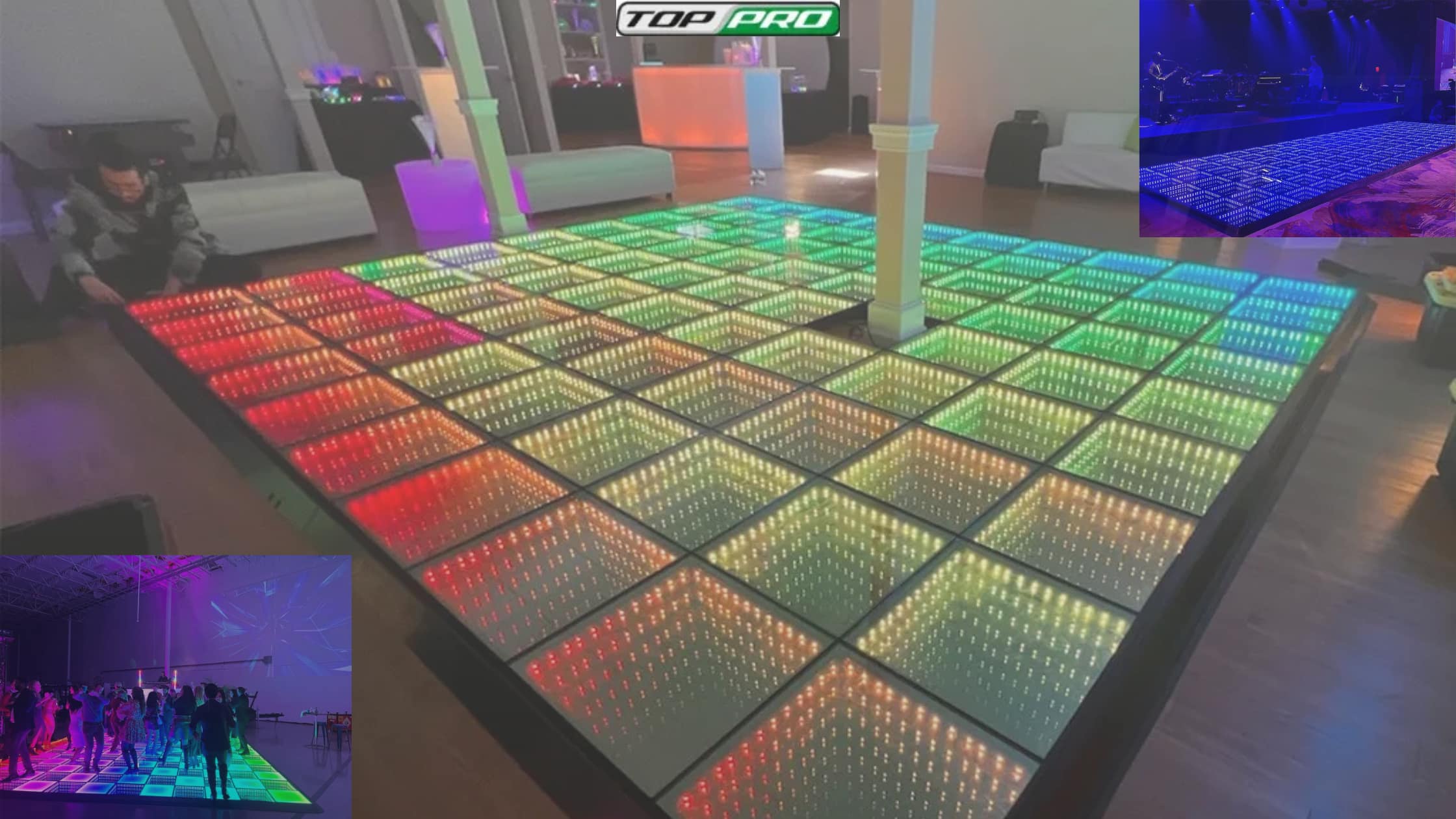
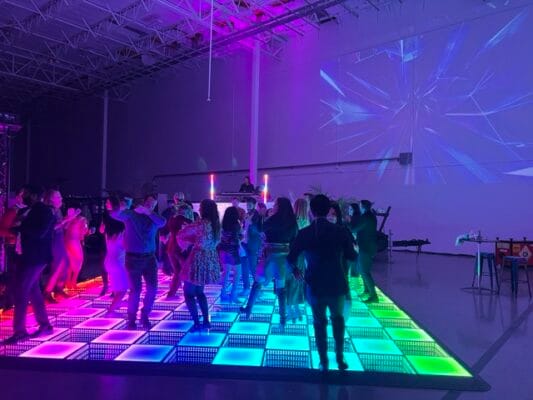
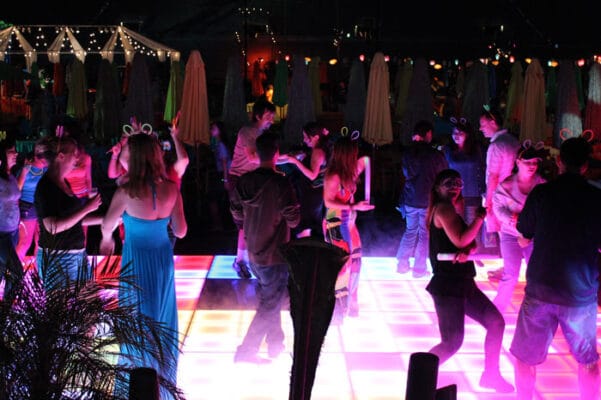
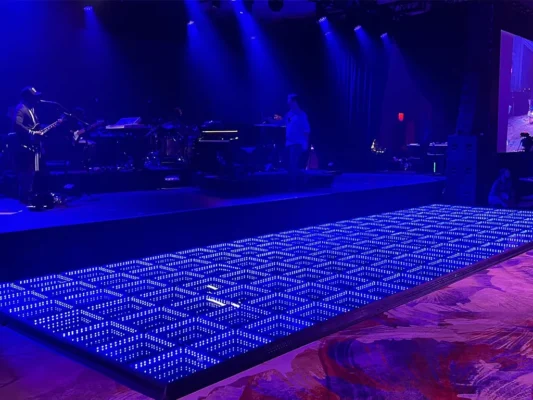
An LED dance floor is a floor built from lit panels, usually 50 × 50 cm each, that lock together into any size you need. The four main types are pixel, 3D infinity mirror, interactive and video floors. For most events, allow about 0.4 m² per dancer, around 40% of guests dancing at once, and at least one 13 A circuit per 64 panels.
Quick Summary
Size by guests. 100 guests need about a 4 × 4 m floor (64 panels).
Pick the type by the room. 3D floors need a darker room; pixel floors work anywhere; interactive floors suit kids and brand activations.
Power is the most common mistake. A 4 × 4 m floor can draw more than one UAE socket can handle, so split it into two circuits.
A level base matters more than the panels. On sand, grass or old tiles, build on stage decks first.
Setup takes 2–4 hours for a medium floor, including testing.
Who this guide is for: event organisers, wedding planners, DJ companies and venue owners in the UAE who are working out what size and type of LED dance floor they need, how to power it, and how to install it without surprises on the night.
What types of LED dance floor are there?
There are four main types: pixel, 3D infinity mirror, interactive and LED video floors. They differ in what guests see, how much they cost to run, and which rooms they suit.
Table 1 — LED dance floor types compared
Type
What you see
Best for
Watch out for
Pixel (RGB) floor
Squares of colour, chases, text, simple patterns
Weddings, birthdays, school events
Low-pixel panels look blocky up close
3D / infinity mirror floor
A “tunnel” of lights that seems to go down into the floor
Weddings, VIP areas, photo moments
Effect weakens under bright room lights
Interactive floor
Lights react where people step
Kids’ parties, brand activations, exhibitions
Pressure sensors add cost and weight
LED screen / video floor
Full video and graphics underfoot
Product launches, stage fronts, concerts
Needs a video processor and more power
You’ll also see floors described as “magnetic”. That describes how the panels connect, not how they light up. Magnetic and clip-lock connectors both let you build squares, rectangles or L-shapes quickly. Check which system a floor uses, because panels from different makers rarely fit together.
You can compare the pixel and 3D models we stock in our LED dance floors for sale in Dubai. For example, the 64-pixel LED dance floor for weddings is a pixel panel, and the RGB 3D LED dance floor gives the infinity-tunnel effect.
How big should your dance floor be?
Allow about 0.4 m² for each dancer, and assume around 40% of your guests will be dancing at the same time. A floor that is too big looks empty in photos. A floor that is too small pushes people off the edges, which is where trips happen.
Table 2 — How big should your LED dance floor be?
Guests
Dancing at once (~40%)
Floor area needed
Suggested size
50 × 50 cm panels
50
20
~8 m²
3 × 3 m
36
100
40
~16 m²
4 × 4 m
64
150
60
~24 m²
5 × 5 m
100
200
80
~32 m²
6 × 6 m
144
300
120
~48 m²
7 × 7 m
196
This is a rule of thumb. Weddings with a big dance culture, and young crowds, may need to go one size up. Corporate dinners usually need one size down. Square floors fill up better than long, narrow ones, because guests gather in the centre.
Scenario (illustrative): a planner is setting up a 120-guest villa wedding in the garden. The “table” answer is about 5 × 5 m. But the lawn slopes, and the DJ booth has to sit on the only flat patch. The better plan is a 4 × 5 m floor on levelled stage decks, placed right in front of the DJ, with edge ramps on three sides. It’s a smaller floor, but it’s safe, level and full all night.
How much power does an LED dance floor need?
Plan for about 30–50 W per 50 × 50 cm panel, so a 4 × 4 m floor needs roughly 2–3 kW. One UAE 13 A socket on 230 V gives about 3 kW at most. A medium floor sharing a socket with the sound system will trip it, usually in the middle of the first dance.
Table 3 — Power planning on UAE 230 V circuits
Floor size
Panels
Typical load*
13 A circuits to plan
Tip
3 × 3 m
36
~1.1–1.8 kW
1
Dedicated socket, not shared with sound
4 × 4 m
64
~1.9–3.2 kW
2
Split the floor into two power runs
5 × 5 m
100
~3–5 kW
2–3
Ask the venue for circuit locations early
6 × 6 m
144
~4.3–7.2 kW
3
Consider a distribution box
7 × 7 m
196
~5.9–9.8 kW
4
Plan power with the venue electrician
*Estimate based on typical 30–50 W panels. Your panel’s spec sheet has the real figure; 3D and video floors often draw more.
Keep the dance floor, the sound system and the lighting control on separate circuits where you can. That also cuts the chance of hum in the speakers.
How do you install an LED dance floor?
Level the base, lay the panels from one corner, fit the edge ramps, connect power and data, then programme and test before any guest arrives. For a 4 × 4 m floor, expect 2–4 hours.
Table 4 — Installation checklist and timings
Step
What to do
Time (4 × 4 m floor)
1. Survey
Measure the space, check level, locate power, confirm access route
Before event day
2. Base
Level the subfloor; use stage decks on grass, sand or uneven tiles
30–60 min
3. Lay panels
Start from one corner, lock each panel, keep joints tight
45–90 min
4. Edges
Fit ramps / edge trims on all open sides
15 min
5. Cabling
Chain power and data as per manual, tape and cover every run
20–30 min
6. Programme
Load effects, set brightness, test sound-active mode
20–30 min
7. Test
Walk every panel, run each effect, check for dead pixels
15 min
The steps installers most often skip
Levelling. Even a small slope makes panels rock and joints lift. Use adjustable stage decks from our stage equipment range under the floor on grass, sand or uneven tiles.
Edge ramps. Every open side needs a ramp or trim. Guests in heels are the reason.
Cable routes. Run power and data under the floor or along the back edge. Never run cables across the path to the bar.
A walk test. Walk every panel before guests arrive. A loose panel shows up under a single person.
How do you control an LED dance floor?
Most floors come with a controller that has built-in effects and a sound-active mode, and many also accept DMX. Built-in effects are fine for a party. DMX lets you programme the floor together with your moving heads and wash lights, so the whole room changes colour at the same moment.
If you’re new to DMX, read our DMX lighting control guide before event day. Keep the floor’s brightness at about 60–80% indoors: at full brightness it overwhelms faces in photos. A few beam moving heads above the floor add height to the show, so all the light isn’t coming from underfoot.
What changes for an LED dance floor in the UAE?
In the UAE, heat, sand and evening dew are the main risks, along with the outdoor-season rush.
Heat. Panels left in direct summer sun get hot and age faster. Install after sunset for outdoor events, or keep them covered until guests arrive.
Sand. Grit in the joints stops panels locking and scratches the top surface. Sweep the base before laying, and wipe the panels before packing.
Dew. Outdoor winter evenings (roughly October to April) can leave glass surfaces damp and slippery. Keep a microfibre cloth at the DJ booth.
Effects. Low fog and cold sparks look great on an LED floor, but keep the spark machines at the floor’s edge, never on it. Read our cold spark machine comparison before planning a first-dance moment.
Peak season. National Day (2 December) and the winter wedding season fill diaries fast. Book equipment or place orders weeks ahead.
Should you buy or rent an LED dance floor?
Rent for a one-off event. Buy if the floor will work regularly: for a DJ business, event company, venue or hotel. Rental fees are charged each time you use the floor, while a floor you own keeps working for years.
TopProSound sells dance floors and doesn’t rent them. So we’ll be straight with you: if you only need a floor once, renting makes sense. If you expect to use it at several events a year, compare a season of rental fees with the purchase price. Our rent vs buy cost breakdown shows how to do that maths for lighting gear.
Frequently asked questions
How big should a dance floor be for 100 guests?
Plan for about 16 m², which is a 4 × 4 m floor or 64 panels of 50 × 50 cm. This assumes around 40% of guests dance at the same time.
How much weight can an LED dance floor hold?
It depends on the model. Quality panels are rated to carry dancing crowds, often in the range of hundreds of kilograms per panel. Always check the load rating on the spec sheet before booking heavy items like a piano or a car reveal.
Can an LED dance floor be used outdoors in the UAE?
Yes, on a level base and in the outdoor season (roughly October to April). Use stage decks on sand or grass, cover all cables, and wipe off evening dew, which makes glass surfaces slippery.
How long does it take to install an LED dance floor?
A 4 × 4 m floor usually takes 2–4 hours from an empty space to a tested floor, including levelling, cabling and programming. Larger floors or uneven ground take longer.
What is the difference between a 3D and a pixel LED dance floor?
A pixel floor shows colours and patterns across its LEDs. A 3D (infinity mirror) floor uses mirrors to create a tunnel of light that seems to go deep into the floor. It looks best in darker rooms.
How is an LED dance floor controlled?
Most floors run from a controller with built-in effects and a sound-active mode. Many also accept DMX, so they can be programmed together with the rest of your stage lighting.
Should I buy or rent an LED dance floor?
Rent for a one-off event. Buy if you run events, a venue or a DJ business and will use the floor regularly, because rental fees add up quickly.
Choose the floor your crowd will actually fill
Size the floor by how many guests will dance, not by the size of the room. Pick the type to suit the lighting in the room. Plan power on separate circuits, and level the base before the first panel goes down. Get those four right and the floor will run all night.
Ready to choose? Compare the 3D disco tile LED dance floor online, or visit our Dragon Mart store in Dubai with your guest count and floor measurements. We’ll help you work out the panel count, controller and power plan.